
B2B marketplace · Technology-grade grown diamond
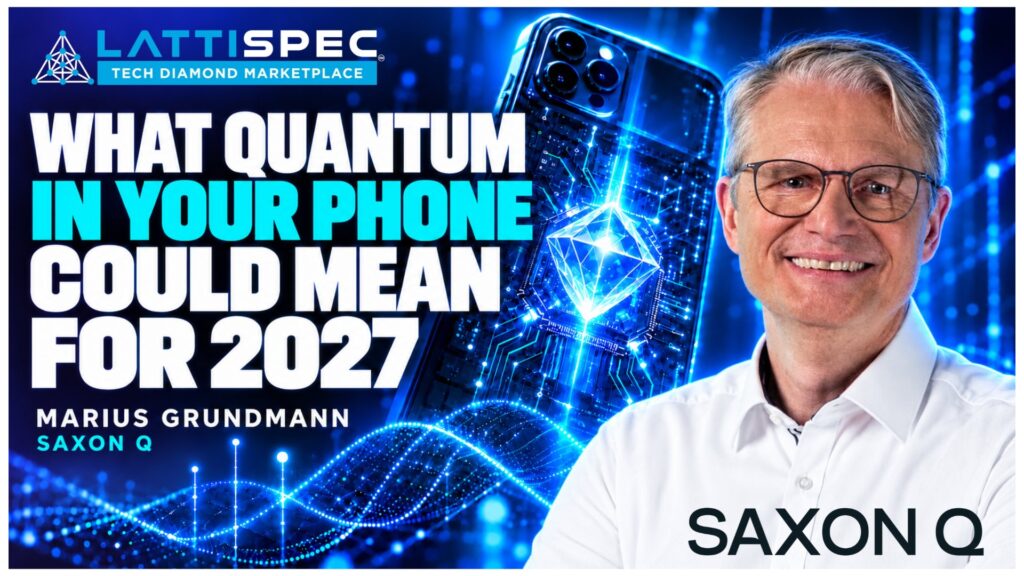
What will it take to make quantum computers smaller, more affordable, and accessible to more industries?
In Part 2 of our conversation with SAXON Q CEO Marius Grundmann, we explore how NV centers in lab-grown diamond could help make mobile, scalable quantum computing a reality. Marius explains SAXON Q’s approach to miniaturizing quantum hardware, using established semiconductor manufacturing processes, and eventually bringing quantum computing into applications far beyond traditional computing facilities. But scaling this technology presents an important challenge for the diamond industry: material quality and consistency. SAXON Q is already evaluating diamond chips from approximately a dozen producers, and Marius explains why improving material reproducibility will become increasingly important as quantum chips advance. This is an exclusive look at how quantum technology is evolving and the opportunities it could create for diamond growers, suppliers, and semiconductor manufacturers.
Missed part 1? Watch it here
Marius Grundmann: The energy use of artificial intelligence is a big issue.
Marty Hurwitz: And part of the reason for this, I’m sure you can explain this better than I, is the way qubits exchange data through entanglement, as opposed to the transfer of electronic charges.
Marius Grundmann: Yes. The principle of quantum computing is to use a comparatively small number of entities, the qubits, and achieve a lot.
So, you know, if you think about 50 qubits, the memory they can address is more than that of 16,000 NVIDIA GPUs. It’s an exponential thing, and exponential processes are not something the human brain is made to understand. And two to the power of 80 is more than the number of atoms in the universe.
So the configuration space that a quantum computer can achieve with a few qubits is gigantic. And, say, one NVIDIA GPU’s memory is equivalent to about 32 qubits. So with a very small number of qubits, you can address a very large memory if you want. That’s one of the ideas behind this resource.
It’s a resource that has been untapped so far, and we’re trying to tap into it. There are two effects, although neither is new: superposition of quantum information and entanglement. The smart use of those in a quantum algorithm gives you an advantage. I always say that a classical algorithm starts with an idea of how to solve a problem.
How do I solve the problem, actually? How can I convert that into code? The same is true for a quantum algorithm. You need an idea of how to tackle the problem with the tools you have, which are superposition and entanglement. There are a bunch of algorithms now, even libraries of algorithms, and I hope, and I think, there will be even better algorithms coming.
That’s a very active field: how to optimally use these qubit resources and make the most of them. That’s the trick. You have a very small number of items that do a lot. That’s the fundamental idea behind it. If you only control, say, 30 entities, that’s cheaper than having billions of bits moving around.
Marty Hurwitz: One of the interesting questions I saw online yesterday was about navigation on ships. You addressed this, and I thought it was interesting. Obviously, it’s a pretty harsh environment, but the smaller footprint of your computers may allow increased mobility and even some unusual locations for the computers.
Is that fair to say?
Marius Grundmann: Absolutely, yeah. We are the mobile quantum computing company. If we miniaturize the control electronics, which we currently buy from a supplier, the core of the whole system is no bigger than this, and we’ll shrink it even further.
It’s already a smaller system. We’re a small startup at this point, but we’re in an explosive growth phase, and we’ll miniaturize it even further. Putting our current quantum computer on a ship, bus, or train is not a problem. But the eventual target is smaller things, such as a car, robots, or maybe your iPhone.
That’s the eventual goal if we can put everything on the chip. It’s semiconductor technology, and it uses electrical signals in the end, so there’s no reason not to accomplish this. But, of course, it’s an engineering effort. A ship would be a relatively easy environment because there’s a lot of space on a vessel.
But the vessel moves, and that movement is probably not good for many other types of quantum hardware. What I should say is that navigation signals themselves are more a topic for quantum sensing. Of course, our quantum computers also have sensors, in a sense, because we measure the qubits and see what they do. But quantum sensing itself is a slightly different field.
They try to measure the Earth’s magnetic fields and navigate using them, perhaps in contested areas, GPS-free areas, or areas with disrupted GPS signals. That’s a big field, but it’s not our main product. Quantum computing can use those data efficiently, for example, to extract a navigation strategy: where to move.
Do I go left or right? Where do I move? But sensing itself is not a core target here.
Liz Chatelain: LGDinTECH is now LattiSpec, a global tech diamond marketplace for buyers and sellers. From diamond materials and subcomponents to equipment, post-growth treatments, and services, LattiSpec helps bring more transparency and speed to the technology-grade grown diamond supply chain.
Built for aerospace, defense, semiconductors, quantum, photonics, optics, and more, LattiSpec connects you with verified global suppliers across ten verticals. LattiSpec is where the tech diamond market connects.
Marty Hurwitz: So you mentioned that you’re a startup, although you’re a few years in already, and you’re getting quite a bit of traction, interest, and customers.
What are the next phases for you? What are you hoping to accomplish?
Marius Grundmann: We’re close to closing our Series A investment, which is a round of $50 million. With this, we’ll employ more people. We have 18 people now. They’re highly qualified, but we need more people for everything we’re doing.
We’ll also buy dedicated equipment to set up a pilot line and demonstrate that we can make this with standard semiconductor equipment and put the process into a fab. Then we’ll cooperate with our vendors to miniaturize this technology and make it mass-producible.
Marty Hurwitz: On that subject, do you ever see yourself becoming a diamond grower, or do you think you’ll continue to outsource diamond growth and do the doping in-house?
Marius Grundmann: We’ll definitely do the doping in-house for now. It’s a process that anybody could do if we told them exactly how.
Currently, we don’t grow our own diamonds. Growing diamonds isn’t trivial. By now, we’ve tested about a dozen producers of diamond chips, and their quality and properties vary quite a bit. But we can source diamonds of sufficient quality.
However, you always want better, more reproducible quality. If we move to making several registers on one chip, you need more high-quality real estate on the chip. My background in semiconductor technology is epitaxy. I’ve grown indium phosphide on silicon, gallium arsenide, indium arsenide, and other III-V semiconductors.
At the university, I also work with oxide semiconductors, such as zinc oxide, gallium oxide, aluminum oxide, and nickel oxide. So I have a background in epitaxy. We could grow our own diamonds, but we need to focus right now. The focus is on demonstrating that NV Centers are a fantastic platform for qubits.
I can add a little anecdote. What we do isn’t known to ChatGPT or Claude. It’s a deep-tech startup, and if we were doing things that are already publicly known, it wouldn’t be so exciting. We don’t copy what’s been done; we’re doing something new. It goes so far that we sometimes have to explain to equipment suppliers that their equipment can do what we need it to do, because they’re not even aware it’s possible.
Once we explain it, they understand. In general, what we do is very new, and you can’t necessarily read about it. ChatGPT will give you the wrong answer today. Once we fully publish what we’re doing, ChatGPT will, of course, catch up.
Marty Hurwitz: Is there anything I haven’t asked that you’d like to address?
Marius Grundmann: The main question we need to ask ourselves is: What kind of quantum computer do we want in the future? The answer is that it should be cheap because we will have quantum advantages, such as lower energy consumption or better calculations.
Then millions, if not billions, of people will want to use it, either remotely or directly on-premises. So we’ll need many, many quantum computers. How can we achieve that? The progress of many companies shows steady advances, but eventually it needs to be an affordable system. If it isn’t affordable to people in general, it will be a niche technology that’s very powerful in the hands of a few. To me, that doesn’t sound like a good idea.
Marty Hurwitz: This is a great point you bring up, and I’d like to address it a little further. Not only cheap, but also smaller and mobile. These criteria are part of a trend we’ve seen in classical computing. For quantum computing to reach its full potential, it has to be smaller, mobile, and usable by a range of industries and individuals across different applications.
It sounds like that could be possible in the not-too-distant future.
Marius Grundmann: I fully agree. The disconnect is that quantum computing relies on the smallest things in our world, such as quanta and atoms. But the machine built around them is much bigger than a CPU or a USB stick.
It’s gigantic. It’s a gigantic machine that controls the tiniest things. There’s no fundamental reason for that. You need to get rid of the periphery, and then you have these small systems. Think about a normal transistor: it’s on the order of 10 nanometers. The smallest structures are controlled on the nanometer scale.
We can do it, and we should do it. In our view, the only way is to use semiconductor technology to build these systems. They can be mass-produced and eventually made cheaply. Think about any information device you use: it’s made of semiconductors. This is the way to go.
It’s the only way this technology can be widely deployed.
Marty Hurwitz: Super exciting. Your work is incredibly exciting and groundbreaking. I’d like to keep in touch and follow up later to see how you’ve progressed, because this is a topic of great interest to me and to diamond growers around the world. They’re integral to this technology.
Marius Grundmann: Absolutely. I’m probably the person most happy to report new successes from our technology and company, so I’d be happy to connect again. And hey, diamond growers around the world: give us better material! We’re in contact with a number of companies and discuss their needs for quantum computing.
Most chips are geared more toward quantum sensing. That’s the easier application. You have a lot of NV Centers, and a lot of NV Centers give you a strong signal. But that’s the lower-hanging fruit for the diamond community. Quantum computing offers much greater economic potential if you can control individual atoms.
It’s a harder task than sensing, but it’s worth it. That’s our path.

 LattiSpec Curator
Live
🔒 Private — only visible to the Seller.
The seller has been notified and will reply shortly.