Gabriel Puebla Hellmann: QZabre is a spin-off from ETH Zurich, and we were founded in 2018 as a spin-off from Professor Christian Degen’s group, who is one of the leading scientists in scanning nitrogen-vacancy microscopy. That’s quite a mouthful. The goal has always been to commercialize nitrogen-vacancy technology, but we’re slowly also expanding to what are called other color centers.
This started out as a one- or two-man operation back in 2018 with the support of the professor. We’ve had sales from day one, so we were lucky. And now we’re 23 people in the office. We’re still situated in Zurich, Switzerland. We make scanning nitrogen-vacancy microscopes. And so far we have, I actually lost track, about 25 systems delivered and in the field.
We make the key component of scanning nitrogen-vacancy microscopy: the diamond tips. And, yeah, actually, I think we’ve sold more than 2,000 tips by now. We’ve slowly branched out into different aspects of nitrogen-vacancy diamond-related materials. So we also offer educational kits, and we offer the lab platform to do NV experiments so that researchers can focus on the actual diamond, optical, and laser engineering rather than the software, which is a major part of the work if you need to get a setup running.
But the science, and really most of the actual value creation, is around the diamond itself, so people can offload that onto us if they want to. And it’s coming along nicely. We have a couple of projects where we now see it taking off. And, uh, I recently read that seven or eight years in is the right time to scale up, so let’s see.
Marty Hurwitz: Uh, well, it certainly sounds like you’re progressing very rapidly, which generally means there’s a lot of market acceptance of what you’re producing, so congratulations to you.
Liz Chatelain: If you haven’t visited LattiSpec.com, please do. Our marketplace brings together diamond producers and users of diamond material.
If you’re hitting thermal walls in your production and you need help, diamond can solve problems for you. Take a look at our marketplace. We’re here to help. LattiSpec.com.
Marty Hurwitz: And, from what we understand, in quantum sensing, diamond material is critical, particularly related to NV centers.
Can you tell us a little bit about why diamond is so important to your work?
Gabriel Puebla Hellmann: There are multiple factors, um, but I would say the interesting thing is diamond has, I think, about seven or eight hundred known color centers. Those are defects in diamond that create color. Pure diamond is colorless, so if you want a blue diamond, a red diamond, or, in our case, a purple diamond, these are defects that form inside the diamond, and some of them have quite interesting properties.
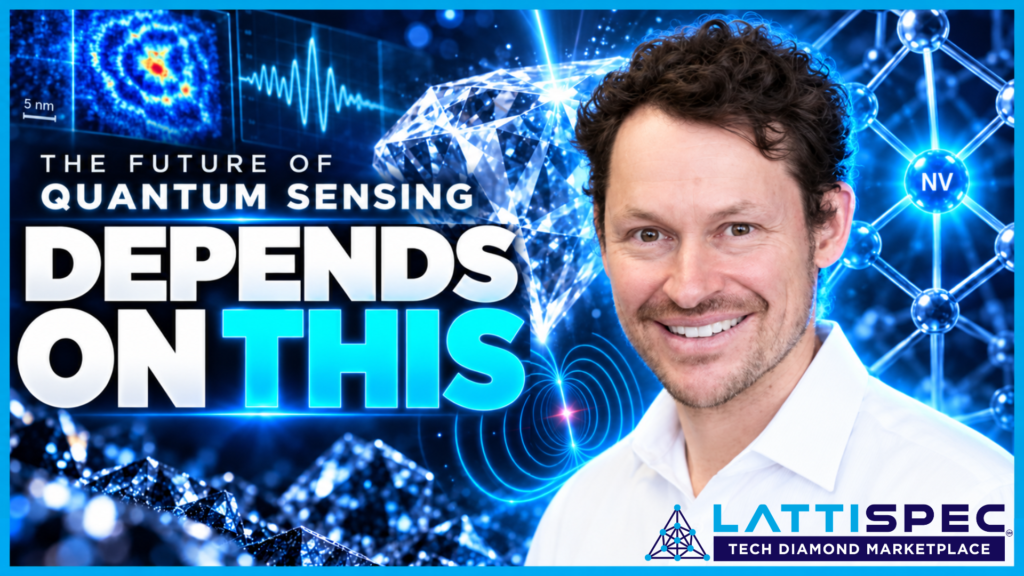
So what you essentially get is an atom-like structure. You have a defect. Sometimes it’s an extra atom; sometimes it’s an extra atom and a missing carbon atom in the lattice. So in our case, a nitrogen vacancy is one nitrogen atom where a carbon atom should be, with an empty carbon site right next to it. These create these atom-like energy structures.
So there you have what look like spectroscopy lines. And essentially you can make states of the electron that’s bound there. It looks like one electron flies around. Usually we use the negatively charged nitrogen vacancy, NV-minus, for the quantum properties that you want for this kind of quantum sensing.
A lot of materials exhibit these kinds of defects. Diamond tends to be one of the better-explored ones, and the nitrogen vacancy as a structure is especially important because it has very long lifetimes as a qubit, and this works even at room temperature. That also ties together with the fact that you can optically address it.
So everything matches up, like the stars line up for the nitrogen vacancy. It’s very sensitive to magnetic fields. You can easily pump it, or spin-polarize it, as we call it. Usually, at room temperature, we have an equal distribution of zero and one, if you look at two quantum states. And we can easily shine green laser light in and make sure that it’s in the ground state.
So this is why superconducting qubits need cold temperatures, because they can’t get into the ground state and keep it there. We can keep it there with green laser light, and then we can drive it to the plus/minus states with 2.87 gigahertz, which is really close to your Wi-Fi band. So electronics and optics match up really well, and then it’s very sensitive to magnetic fields, so we have a lot of features that line up. That makes the nitrogen vacancy pretty much the most important one of the solid-state materials.
And yeah, it’s diamond. It has to be diamond. And then there are good and bad things about diamond being chemically inert, so you can use it for biocompatible things. In our case, we have our diamond defect in a tip, and we move it over the surface, so it’s nice that it’s diamond.
So the tip doesn’t wear down. Rather, you have to worry about scratching your sample. Um, so that’s nice about diamond. Then you have all the downsides. Forming diamond into a nice shape, which is what we do and spend a lot of effort on, is really hard because diamond is also really hard to etch. The one thing that diamond really offers for quantum is that, uh, if you have isotopically pure carbon-12, normal carbon is about 99% carbon-12 and about 1% carbon-13. You can actually get rid of that carbon-13, and then you are left with something that creates essentially zero background for the nitrogen vacancy.
So you have almost, from an ideal point of view, your single nitrogen vacancy, and it doesn’t see anything around it. The carbon lattice is quiet in that sense in terms of magnetic field. Um, and that’s also one of the beauties of nitrogen vacancies. People now do, you know, hexagonal boron nitride and defects, but all of these carry spins and they make background noise. Nitrogen vacancy remains at the forefront here.
And this is also what drives the commercialization. Like, I mean, it’s super sturdy; it’s very robust. There’s still a lot of open questions, uh, but at the fundamental level you can get this working. Almost anybody can get this working in a couple of weeks by reading the literature. Uh, we have a master’s student who built a tiny setup, and that actually works with a tiny, tiny piece of diamond.
Uh, it’s really cool, so you can run this off an Arduino.
Marty Hurwitz: In both the near term and long term, tech diamond material grown to your specs, which are likely very specific, is critical to the future of quantum sensing as you see it?
Gabriel Puebla Hellmann: Yes. The diamond that we use has always been lab-grown because you need a purity of 10 to the minus nine or even better, which we would love to have, and you don’t get that in natural diamond.
It needs to be HPHT, or rather, CVD has been the premier technique for this. Ideally, you want isotopically pure carbon-12, and then it becomes very much a tech diamond that is needed to create these kinds of sensors because it needs to be as clean and defect-free as you can make it, so that we can introduce the defect that we want ourselves, in a controlled manner, so that it forms at the point where you want it.
Marty Hurwitz: You mentioned something very interesting about biocompatibility. It seems like one of the most active research areas of quantum sensing and magnetometry is in the medical arena, both medical tech and medical pharmacology. There are a lot of researchers exploring the use of quantum sensing and diamond quantum sensing in those areas.
Is that what you found as well? We’ve heard of some very exciting medical activity related to this.
Gabriel Puebla Hellmann: I know there’s a market out there and there’s a lot of research going on. I don’t know how much is ready from a commercialization point of view. We’re trying to keep track of this. Uh, we’re kind of more focused on the physics side because that comes more naturally to the company, because we’re mainly physicists and quantum engineers and not biologists.
So my statement has always been there is a market there and there is a lot of interest there, but we don’t have the expertise to really join in on this. I think talking to somebody like, uh, QT Sense in the Netherlands, which is actually trying to market this actively for medical research, is probably a lot more valuable. So there are a few startups popping up there.
You can do NMR, and you can do radical sensing, both of which I think are near-future applications. Uh, you can do temperature sensing with nanodiamonds, which is more exploratory, I would say, but I think we will see medical applications of diamond quantum sensing coming up in the next couple of years, almost to the point of an actual clinical product trial stage, and not just conceptually somewhere in the lab.

 LattiSpec Curator
Live