Jonathan Charak: So Great Lakes Crystal Technologies was founded in 2019 and spun out technology that originated at and was licensed from Michigan State University. We’ve got two facilities in East Lansing with a total of nine CVD reactors to grow diamond. Our co-founder, Dr. Timothy Grotjohn, has been working on diamond at Michigan State University as a professor for nearly 40 years.
A lot of the technology was his — technology he was involved in developing. We licensed his technology and have created some of our own intellectual property along the way. But essentially, Great Lakes Crystal Technologies grows single-crystal diamond substrates for use in high-technology devices, high-power devices, RF devices, as well as quantum sensing and thermal management. Those are our main categories of applications, for which we’re developing the highest-quality single-crystal diamond.
Marty Hurwitz: I’m certainly aware, and we are tracking this tech diamond supply chain as it evolves, and it’s really growing quite rapidly. I think one of the things our audience would love to know about, especially those in the tech community, is why technology-grade diamond material is so important to the future of fields like quantum sensing and high-power electronics?
Jonathan Charak: Simply put, single-crystal diamond as a material has inherent physical properties that simply can’t be matched by other materials like silicon, silicon carbide, or gallium nitride. It has the highest level of thermal conductivity, which is critical for many devices. It’s highly resistant to extreme radiation and can operate at regular temperatures and serve in functions that other materials cannot operate under.
It’s an ultra-wide-bandgap material, which means that in an electronic device it can be a lot smaller, absorb a lot more power, and be much more efficient. And in terms of quantum sensing, the diamond itself, when irradiated — leaving a nitrogen vacancy — a free electron within that vacancy is very sensitive to magnetic fields.
So the diamond itself becomes a quantum sensor, very sensitive, for applications such as navigation without GPS. Whether it’s a military vehicle or device, drones can operate without getting jammed — GPS signals get jammed regularly. And it can also help look into the human body and medical devices at a much greater level of detail to help on the medical side.
So quantum sensing is important. And just basic thermal applications, even if the diamond itself isn’t active in doing these other functions — it simply absorbs heat and can remove it from any device. Its higher conductivity means it gets the heat out faster, so the devices can operate better.
LattiSpec Ad Read: If you haven’t visited LattiSpec.com, please do. Our marketplace brings together diamond producers and the users of diamond material. If you’re hitting thermal walls in your production and you need help, diamond can solve problems for you. Take a look at our marketplace. We’re here to help. LattiSpec.com.
Marty Hurwitz: It seems like, as we track the different diamond growers in the world that are trying to get into the tech diamond space, most have a pretty limited focus on specific applications. Maybe they can grow two or three different types of material. But at Great Lakes, you guys seem to be expanding your product portfolio, which is terrific, because there are wide sections of the tech community that want to use diamond material. Can you tell us a little bit about your product portfolio as it’s evolved in 2026?
Jonathan Charak: Yeah. I think many of the players in the diamond growth space began life as gem diamond producers for the jewelry industry. As Asia ramped up their production and flooded the market, that became not such a viable business. And so a lot of those guys are trying to convert to deep-tech diamonds. But as I mentioned earlier, our co-founder, Dr. Timothy Grotjohn — this is all we’ve ever done. That’s all he’s ever done. We were never in the gem-diamond business, so we believe we have a bit of a head start on many of these other people in our capabilities.
Our product portfolio, as I mentioned, revolves around three primary applications: thermal management, power electronics, and quantum sensing. And we continuously develop around those three. In all three cases, we do believe that in the long term there are going to be substantial markets, and diamond will replace current materials in all three of those categories.
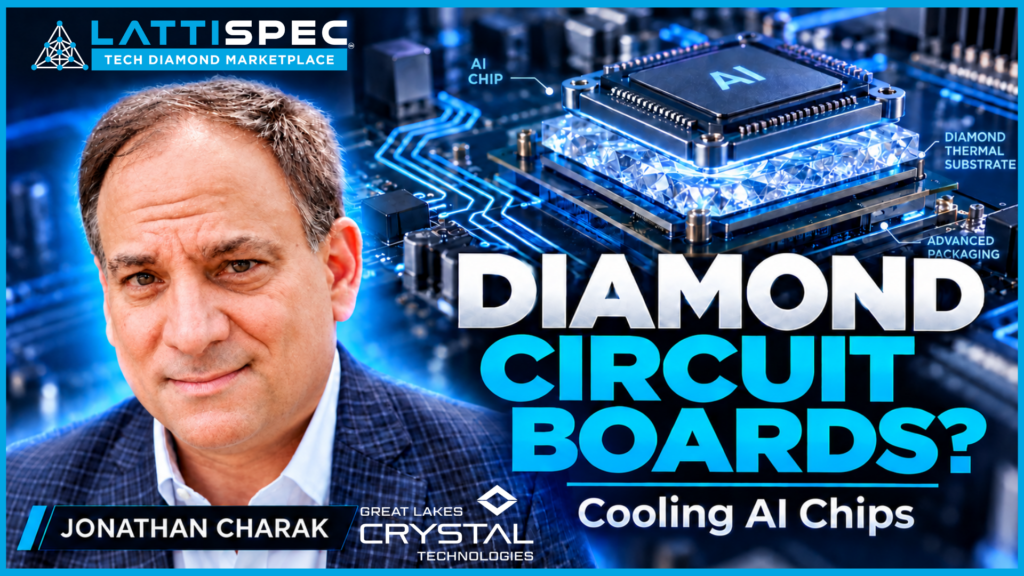
In terms of thermal management, we’re working on actually making printed circuit boards out of diamond, and other components within the semiconductor package itself. So diamond will not only take the heat away, but will actually perform the same function that those other components typically do. The thermal-grade diamond, in terms of quality, is not quite as sophisticated as the electronics and quantum-sensing grades. But the processes we’ve developed to prepare the surface of the diamond so that it can fit into the semiconductor package are unique, and something we’ve been working on heavily.
We’re also a big participant in a number of government programs to advance the development of diamond as components in power electronics — transistors and diodes — and actually making these components out of diamond for all the reasons I’ve already talked about. Not only can it absorb the heat and get rid of the heat, which is critical to the operation of any device, but it’s actually able to absorb more power and work more efficiently. And because of these great properties, it can become smaller and lighter, which is important for things such as drones and anything where size is an important factor. So it really is a miracle material that can solve many problems at once.
Marty Hurwitz: Yeah. We’ve started calling it the dawn of the tech diamond age. It is such an incredible material, and most people don’t even know about it. Even a great many of the tech developers don’t even know what the possibilities are. It sounds like you’re exploring some significant areas. Either in your work or in general, where do you see some of the first commercially viable products scaling in this arena?
Jonathan Charak: Yeah. We’re excited about all three of the applications I reviewed. We believe the one that’s closest to real commercial traction is on the thermal side. And I say that because all these applications would benefit greatly from the addition of diamond into their product portfolio. However, on the electronics side and the quantum-sensing side, a lot of these devices themselves are still being developed.
Whereas today, on the thermal side, there’s already a significant pain point in AI chips and other semiconductor packaging. There’s already a product and there’s already a severe pain point that diamond can solve. So the sooner we can get these — especially this printed circuit board concept that we’ve developed for a thermal application — into the hands of the OEMs and the people developing these technologies, then they can test them and integrate them into their existing product, and the sooner this will take off.
Again, there’s already a pain point, there’s already a device — compared to some of the other categories where these parties are still developing their GPS-free navigation, their magnetometers, for example. So in the timeline of how this is going to develop, I just think that thermal is on deck and ready to be served, compared to some of the other ones, which are a little bit further afield in their development cycle.
Marty Hurwitz: Totally agree with that. In fact, we know just from inbound inquiries on our side that the demand for thermal management, particularly in AI servers, is massive. And the supply is limited. It’s not so easy to provide the solution, and it’s certainly not so easy to scale the diamond solution. So yes, that is a very active usage of tech diamond material, and the number of solutions, products, and wafers that people are looking for is already significant. Unfortunately, many of the growers are not really up to speed to be able to produce that. So it’s great that you’re leading the charge in that, and we certainly wish you a lot of good luck with it.


 LattiSpec Curator
Live
LattiSpec Curator
Live