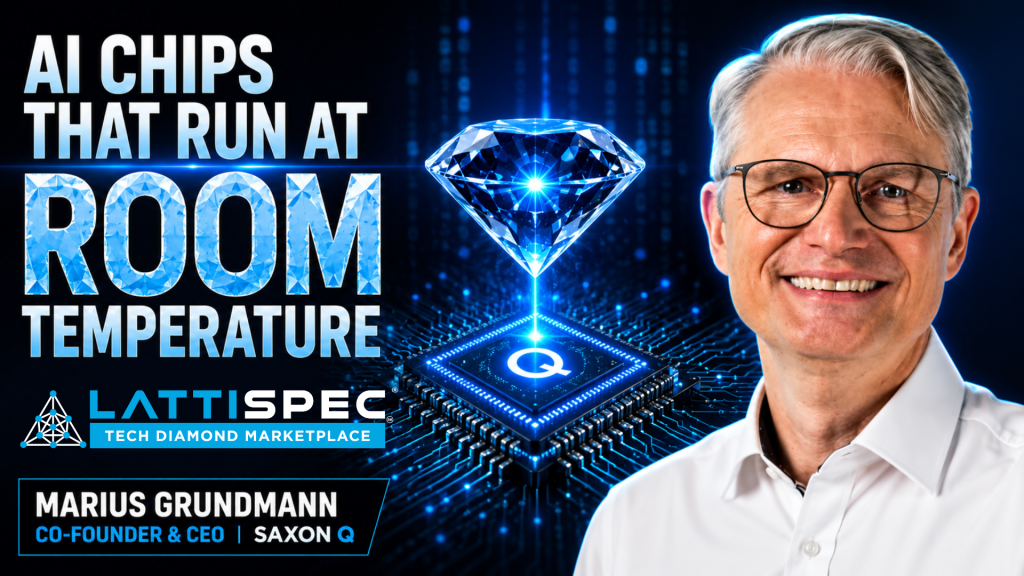

Quantum computers usually come with some pretty serious cooling requirements. SAXON Q is taking a very different approach.
In this episode of LattiSpec News, Marty sits down with Marius Grundmann to talk about how SAXON Q is using NV centers in diamond to build full-stack quantum computers that can operate in normal air at room temperature.
Marius breaks down how the diamond chip works, why SAXON Q is developing multicore quantum systems, and how this technology could eventually deliver more computing power with a smaller footprint and lower energy demands.
They also get into what this could mean for data centers and the future of high-performance computing.
And make sure you stick around until the end. Marius has a message for the diamond industry about the cleaner, more consistent material quantum computing will need as it continues to scale.
Learn more about SAXON Q: https://www.saxonq.com/
Marty Hurwitz: Marius, again, thank you for taking the time to speak with us. This is a very exciting topic, and we’re thrilled that you’re joining us. As a starting point, can you give us an overview of your work at SAXON Q and the exciting things you’re working on?
Marius Grundmann: Yeah, I’m happy to tell you about SAXON Q. We’re a deep-tech startup. We’re five years old now, and we build quantum computers based on NV centers in diamond. More generally, we’re talking about color centers in transparent, wide-bandgap semiconductors, but the specific spin system we use for our quantum computers is the NV center in diamond. We’re a full-stack company, so we build the entire computer from scratch.
The core of it is, of course, a diamond chip with the qubits. The computer also has a full software stack, so you can execute quantum code directly on the chip.
Marty Hurwitz: And I read your recent post on LinkedIn. It was quite fascinating, and the responses were actually very interesting as well, with people talking about different applications. It seems like the evolution of diamond growth has become very significant to the SAXON Q product. A lot of our viewers and listeners understand a little about NV centers and their relationship to qubit locations, and I gather that this is critical to your product.
Marius Grundmann: Absolutely. The core of the quantum computer is the diamond chip. The diamond chip hosts all the qubits, and we were indeed very pleased with the response to our announcement of the 128- and 512-qubit quantum computers based on NV centers. Just to be clear here, we need to distinguish between the core we have, which is the qubit register, and the number of cores.
Currently, we ship 16 cores with eight qubits each, and then we move to 32 cores with 16 qubits each. Eventually, we will move to 32 qubits per core, and then to 64 or 128 qubits per core in later generations. That gives us an increasing number of qubits that can be entangled. In our view, it is extremely important to have many of these quantum computers because there will be many users.
You have problems that can be separated, and those problems can be worked on in parallel. And let’s not forget that a quantum computer always produces a statistical result by definition. Computations must be repeated to produce that statistical result. That repetition is normally performed on the same quantum computer, but we can run the repetitions in parallel across these cores and accelerate the calculation.
Coming back to your question, the diamond chip we use houses the qubits in the following way. The NV center itself is a lattice defect in the diamond. Let’s assume we have a perfect diamond with a tetrahedral arrangement created by the tetrahedral bonding of the carbon atoms. We then replace one carbon atom with a nitrogen atom, and next to it must be the V, or vacancy. So it’s a two-site defect, which is already a defect complex.
In detail, it needs to be negatively charged. This is not a trivial task. Think of the diamond’s band gap: here is the valence band, where all the electrons are, and then there is the conduction band. It’s a wide band gap. The band gap is more than five electron volts, so it’s very unlikely that there are electrons in the middle. The NV center has an energy level in the middle of the band gap, so the Fermi level, which describes the chemical potential of the electrons, needs to be high enough.
Diamond is typically a p-type material, and achieving n-type doping is not easy. That difficulty has held diamond back somewhat from some applications. Diamond is otherwise an ideal material for high-power electronics, for example. But n-type doping is difficult to achieve. When we dope the diamond, the electrons fall into the NV center, and with our patented sulfur-doping process, we create stable, negatively charged NV centers. Two things are necessary to create our NV centers: nitrogen and sulfur doping. The sulfur helps provide the negative charge and also helps form the nitrogen-vacancy complex with very high yield.
Marty Hurwitz: So that doping is a post-growth treatment. You receive the grown diamond in a particular condition, and then you dope it yourself?
Marius Grundmann: Yes, we do that ourselves. We source the diamond because we are not currently growing our own diamonds. We source it as a chip and hope that it is as clean as possible. That hope is usually fulfilled, but not always. Ideally, there would be only carbon in the diamond, but we know it’s impossible to make diamond that contains only carbon. There will always be other impurities.
We need diamond with as few impurities as possible because we dope it ourselves. We dope it only very locally, so we’re adding single atoms. To create one NV center, we implant one nitrogen atom. Together with nearby carbon-13 nuclei, one NV center gives us eight qubits. We can get into that detail a little later. We then create a second NV center to produce a 16-qubit register. With a two-by-two arrangement of NV centers, you have four times eight, or about 32 qubits. Yet this entire area, with the centers very close together, is much smaller than one square micrometer. On a chip measuring a few square millimeters, we therefore use only a very small portion.
LattiSpec Ad Read: LGDinTECH is now LattiSpec, a global tech diamond marketplace for buyers and sellers. From diamond material and subcomponents to equipment, post-growth treatment, and services, LattiSpec helps bring more transparency and speed to the technology-grade grown diamond supply chain. Built for aerospace, defense, semiconductors, quantum, photonics, optics, and more, LattiSpec connects you with verified global suppliers across 10 verticals. LattiSpec is where the tech diamond market connects.
Marty Hurwitz: You said earlier that you’re shipping systems with multiple qubits. Does that mean there are multiple chips in those computers?
Marius Grundmann: That’s an extremely good question. Yes. At this point, each core, if you want, is its own quantum computer, and each core has its own chip right now. But as I said, because we need less than one square micrometer for these registers, our roadmap calls for building multiple cores on a single chip. On a single chip, you could make 1,000 cores. That is more a question of the wiring than of making the qubit registers. It will be extremely efficient because you could have 1,000 quantum computers working in parallel on one diamond chip. There is a lot of real estate on a square-millimeter diamond chip for many qubits because a qubit is atomically small.
Marty Hurwitz: Okay. Yeah, that’s a lot of computing power, more than we’ve ever seen before.
Marius Grundmann: That’s the target. Absolutely.
Marty Hurwitz: Without revealing any trade secrets, what types of customers are interested in your products, or are already using this technology?
Marius Grundmann: That’s not a big secret. We have customers in the research sector. The German Aerospace Center runs one of our quantum computers, and we’re delivering the next one this year. A Fraunhofer institute focused on robotics, which operates as a kind of public-private partnership, also runs one of our quantum computers.
Since our announcement, we have had a lot of interest, ranging from cancer diagnostics, which is essentially an image-classification problem, to topics such as public safety and defense, as well as high-performance computing (HPC) integration. The question is: how do we get this into a high-performance computing center? The typical thinking right now is to add a quantum computer to HPC. In HPC, you may have 10,000 or 20,000 GPUs working together. So you will not need just one quantum computer; you may need 10,000. You need a technology that can eventually deliver thousands, if not millions, of quantum computers. In my view, this can only be achieved with semiconductor fabrication and semiconductor technology.
We should also tell our listeners that the computers we ship work under ambient conditions, so there is no cooling involved. These qubits work in diamond at room temperature. Ambient conditions also mean operation in air, so there is no vacuum involved. The chip is sufficiently passivated to work in normal air at room temperature. To be precise, because there are electronics in the box, the temperature may be around 30 degrees Celsius. There is a PC in there that organizes everything. So it is actually a little warmer than room temperature, if you want to be precise. But to summarize, quantum computers will go everywhere, and there is very broad interest in integrating them into systems right now.
Marty Hurwitz: You bring up a major point that is particularly relevant at this moment in time: the cooling systems required to run giant server farms, for example, are becoming unsustainable. What your product and development are ushering in is room-temperature processing without cryogenics, along with a much smaller footprint.
Marius Grundmann: Absolutely. Those are really three issues you bring up. Let’s talk about the footprint first. Our quantum computer is the smallest in the world. It is a very simple system compared with other setups, which may require heavy optical tables, a vacuum, and very sophisticated cryogenic equipment. We will continue to reduce our footprint dramatically so we can fit more and more quantum computers into one server rack. Currently, we fit about 16 quantum computers into one rack, but the number will increase in powers of two. Eventually, we will have 1,000 computers in one box.
The energy aspect, or power consumption, is also extremely important. There are two comparisons: a quantum computer versus classical computing, such as GPUs and CPUs, and our quantum computer versus other quantum computers. The second comparison is the easier one. Our computer uses the least power of any quantum computer because it is such a simple system. If you look at an IBM system, for example, the published figure for the dilution cryostat is 50 kilowatts, or 50,000 watts, and most of that power goes into the peripheral systems rather than the quantum computation itself. Our quantum computer has fewer qubits, but if we have a multicore system with a comparable number of qubits, we may use about two kilowatts. One of these chips needs around 100 watts or something like that. So it is orders of magnitude smaller.
The more interesting question is how the energy consumption of quantum computing compares with GPUs and HPC systems. The easiest quantum advantage you can achieve is to perform the same calculation on a quantum or classical computer and show that the quantum computer uses less energy because it is more efficient in its energy use. The basic question is: where does the GPU lose energy? The GPU loses energy by moving all the bits through memory. In a quantum computer, you do not move electrons; you move only information. Ideally, the process is dissipationless and would not need any energy because it is reversible. Thermodynamically, that is not the case in practice, but our goal is to make a quantum calculation more energy-efficient than a classical calculation for the same result. That is the first quantum advantage you can achieve.
That does not mean you are already cracking every code and so on, but it is extremely important in practical terms because the energy use of artificial intelligence is a major issue. And to the diamond growers of the world: give us better material. We are in contact with a number of companies and are discussing the needs of quantum computing with them. Most chips are geared more toward quantum sensing. That is the easier application. A large number of NV centers gives you a strong signal, so this is lower-hanging fruit for the diamond community. The much greater economic opportunity, however, is in quantum computing, where you need precise control of individual atoms. It is a harder task than sensing, but it is worth it, and that is our path.
🔒 Private — only visible to the Seller.
The seller has been notified and will reply shortly.