Why Diamond? The Physics of Wide-Bandgap Quantum Substrates
Conventional superconducting quantum processors (such as those from IBM or Google) rely on transmon qubits operating near absolute zero (0 K) inside complex dilution refrigerators. In contrast, solid-state spin qubits hosted in diamond leverage the unique intrinsic properties of synthetic single-crystal diamond to achieve quantum coherence under far less restrictive environmental constraints.
Ultra-Low Magnetic Noise & Rigid Carbon Lattice
Diamond consists of a tightly bound, rigid sp³ hybridized carbon matrix. This dense structure isolates embedded quantum systems from thermal phonons and mechanical vibrations. Furthermore, high-purity synthetic diamond enriched with Carbon-12 (¹²C) eliminates nuclear magnetic spins, creating an exceptionally “quiet” electromagnetic environment that prolongs quantum coherence T₁ and T₂ times from microseconds into milliseconds.
Engineering the Nitrogen-Vacancy (NV) Center
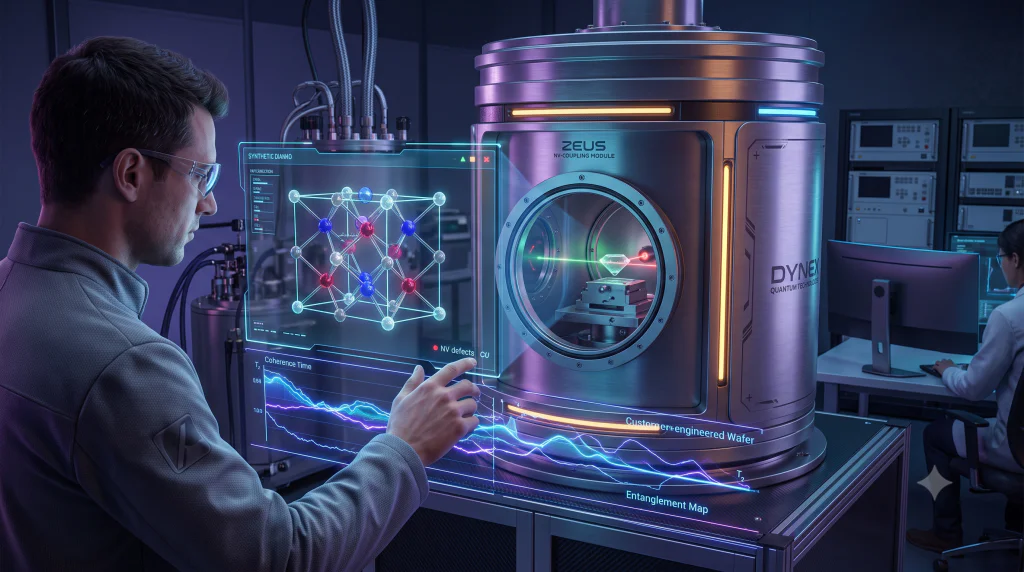
The computational core of the Zeus module relies on engineered defects inside the tech diamond lattice:
Lattice Substitution: A nitrogen atom replaces a carbon atom in the diamond crystal during Chemical Vapor Deposition (CVD) growth.
Vacancy Binding: An adjacent carbon position in the lattice is left empty (a vacancy), trapped during irradiation and thermal annealing.
Electron Spin Trapping: The resulting NV center captures an extra electron, creating a localized S = 1 triplet electronic spin state that can be selectively manipulated with microwave pulses and optical lasers.
Technical Highlights: How Zeus Leverages Synthetic Diamond
| Substrate Property | Performance Feature in Zeus Architecture |
| Material Foundation | Ultra-pure single-crystal synthetic CVD diamond enriched with ¹²C |
| Quantum Element | Negative Nitrogen-Vacancy (NV⁻) defect electron spin qubits |
| Coherence Protection | Rigid carbon lattice protecting spin states from environmental decoherence |
| Integrated Memory | Adjacent ¹³C and ¹⁴N nuclear spins |
| Control & Readout | Optically Detected Magnetic Resonance (ODMR) via 532nm green excitation |
| Scaling Mechanism | Patent-pending coupling layer enabling dynamic qubit interconnectivity |
Solving the Interconnectivity Bottleneck
A historical limitation of NV-center diamond qubits has been inter-qubit coupling—since NV spins are localized deep within individual crystal lattices, enabling long-range entanglement between distant qubits required delicate optical photon-mediated coupling.
Dynex’s recent patent filings (USPTO 64/093,378 and 64/093,380) address this scaling barrier by pairing synthetic NV-diamond modules with dynamic optical control layers and bio-organic interconnect materials. This hybrid approach enables flexible, programmable interactions across thousands of defect-spin qubits, scaling up to 9,984 logical qubits per platform without requiring rigid, fixed physical wiring.
LattiSpec Takeaway: Tech Diamond as a Next-Gen Semiconductor Standard
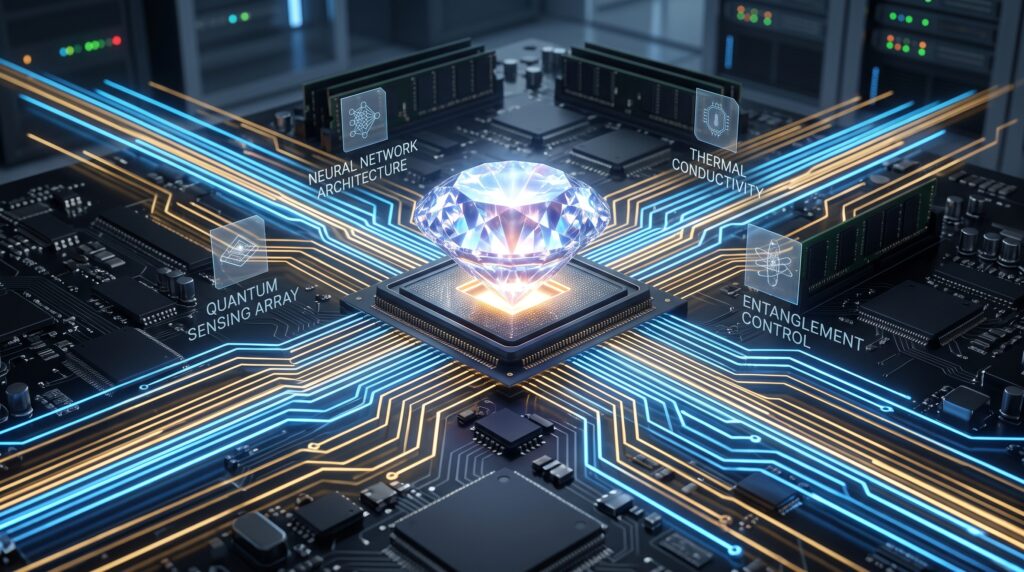
The Zeus announcement reinforces an industry-wide shift: diamond is no longer just a high-power wide-bandgap semiconductor material—it is a prime candidate for room-temperature solid-state quantum hardware.
By combining the natural thermal conductivity, low magnetic interference, and long coherence times of synthetic diamond with programmable optical coupling, Dynex is demonstrating how advanced materials science can bypass the cryogenic limits of traditional quantum computing.
For more technical breakdowns on synthetic crystals, advanced substrates, and deep-tech materials, subscribe to the weekly newsletter at www.LattiSpec.com.