
B2B marketplace · Technology-grade grown diamond
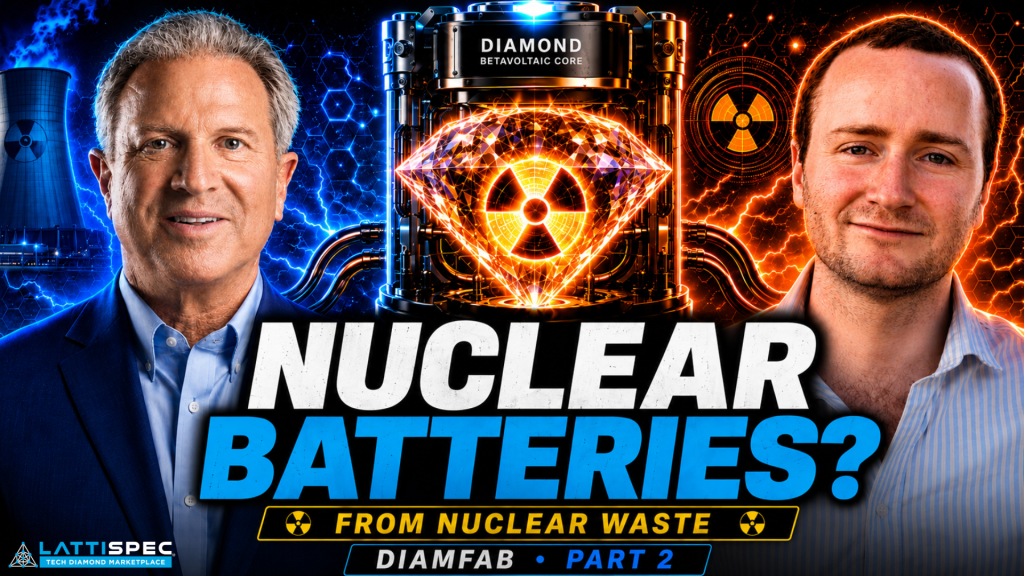
Could nuclear waste become a long-life power source?
In this episode of LGDinTECH Insights, we continue our conversation with DIAMFAB to explore the emerging world of diamond betavoltaic batteries: nuclear-powered devices designed to convert radioactive energy into usable electricity for applications like industrial IoT, civil engineering, harsh environments, and space.
The discussion covers how a French consortium involving DIAMFAB, STMicroelectronics, and CEA came together around tritium-based betavoltaic technology, why commercialization still requires careful regulation and scaling, and why technology-grade grown diamond may be one of the most important semiconductor materials for this future.
Diamond’s ultra-wide bandgap, radiation hardness, low atomic number, and improved commercial availability make it a powerful candidate for next-generation energy conversion. The episode also looks ahead to future work involving ESA and Orano, with potential space applications and nuclear-waste revalorization on the horizon.

Marty Hurwitz: You joint ventured, or you were part of a consortium that developed this product, including STMicroelectronics, which is a gigantic company. Can you tell us a little bit about how you came to work with them and what their reaction was?
Manoël Jacquemin: The project is a French-funded project because, as you know, in France we have a lot of nuclear power. In the U.S., you have more nuclear reactors, but in France most of our electricity comes from nuclear power – around 70%. Because we have a lot of nuclear power, we also have a lot of nuclear waste, and we need to find ways to reduce the amount of that waste and, let’s say, create value from it.
The revalorization of nuclear waste is a main objective for the French government, especially with the new nuclear programs coming in the next decades. There are a lot of grants for companies like ours to find ways to use nuclear waste or improve the nuclear waste cycle.
Betavoltaics started to reappear maybe seven years ago. In the U.S., there was a startup called NDB, if I recall. In the U.K., there was Arkenlight. Betavoltaics started to reemerge after a long quiet period. The technology comes from the 1970s, but after that, almost nobody wanted to use it.
What betavoltaic projects have in common is diamond, and we can talk about later why diamond is used instead of other materials. STMicroelectronics was aware of everything happening in the semiconductor world and said, ‘Okay, let’s try to do the same. Let’s go to France and say we have a way to use nuclear waste by doing betavoltaics.’
Because it was a French project, they said, ‘We need to find an actor with a very good semiconductor.’ So they were looking for diamond, or another very good semiconductor. DiamFab had just been created in 2019, and the project started in 2020 with the writing of the project and grant application.
They contacted us. They are in Grenoble, and we are in Grenoble. It was a team from STMicroelectronics in Grenoble because they specialize in radiation hardness and related topics. They work with many different companies. They contacted us and said, ‘We need diamond, and we need a third actor because none of us know how to use tritium.’
They looked into it, and CEA – Commissariat à l’énergie atomique – is a major French organization that works across public, military, and industrial research. CEA uses tritium because of Cadarache and the tokamak fusion project in the south of France, a project involving many countries. Tritium can be used for fusion, so they know how to handle it.
So you had three French entities with strong knowledge in the three parts of the project. DiamFab is doing the diamond, of course. CEA is handling the tritium, and STMicroelectronics is doing the energy-harvesting solution.
It is nice to have a generator, but then you need to put that energy into something useful. So the harvesting solution is coupled with a battery and adapted for dedicated applications: industry, industrial IoT, civil engineering, and space applications. The sky is the limit. It was a consortium with three entities, and that is how the project emerged.
Marty Hurwitz: Is it the case that STMicroelectronics will be distributing it commercially with their applications? Is that already something being worked on?
Manoël Jacquemin: The original idea was that we are a foundry, and we would supply diamond to build it. It was still a bit unclear who would handle the tritium part – whether it would be another company, a company created specifically for this, or STMicroelectronics diversifying into that area.
And yes, ST was, and still is, the commercial pipeline to reach the market. We are a very young startup, so we are not able to find clients in the same way. We are a small actor in the nuclear world, but not a full nuclear company. DiamFab has many objectives, and betavoltaics is one of them. We are not fully dedicated to nuclear, so we do not have all of the same shared contacts and space.
STMicroelectronics, being the large company it is, knows how to find clients, sell the product, package it, and find regulations that will work for this kind of device. Your question implies commercialization, so I want to be precise: our batteries are not currently sold commercially. We could maybe sell one if needed, but it will take time to address regulation and all of the related steps.
We do not yet have an industrial tool ready to build these batteries at scale. We are trying to develop it, and it will take time. But the technology works. We know how it works. We showed that it works. We know it is possible, and we did it.
Scaling production to an industrial level takes a lot of time and a lot of money. We are still working on R&D to improve capacity, because that gives you a higher-performance device. We are also working on the industrial side with partners, for now STMicroelectronics. If we find another partner, especially one good with tritium handling, that would be very helpful.
Marty Hurwitz: I imagine scaling is expensive, and you have to figure out the best ways to go. It seems, on the surface anyway, that the commercial possibilities are pretty vast. If you think about all of the harsh-environment places where the generator could be used, there are significant opportunities for it.
Manoël Jacquemin: Yes, and even more than harsh environments, the best thing is the lifetime – the lifespan of the batteries. In some places that are not especially harsh environments, 20 years of operating life can save a lot of money.
We know that the markets – let’s put an ‘s’ there, because there are many different markets that can use this device – are huge. We just have to keep in mind that it is a nuclear device. Therefore, we need traceability, nuclear safety, and no possibility of environmental contamination.
Even though tritium is a relatively safe radionuclide for humans and for the environment, because hydrogen does not accumulate in the body and the radiation is low energy, the damage is very low and accumulation is low. Therefore, the nuclear risk is lower than with many other radionuclides.
Still, it is a nuclear device. In order to commercialize it, you need regulation. It will depend on the country, of course, and you also need the public to accept this kind of technology. With tritium, it is easier, or at least less potentially harmful. We think the public can accept this kind of technology because this one is safe, let’s say.
That would not necessarily be the case if we changed the radionuclide, which is something we can do. You choose the radionuclide based on your application – lifetime, efficiency, and what you need it to do. If you look at Chinese companies, for example, they wanted to make a battery that lasts 100 years. A 100-year lifetime sounds gigantic and very nice, but why are you using a battery for 100 years? Is there an application for 100 years? I don’t know.
That approach works with nickel, and nickel can be bioaccumulative. Therefore, if you have contamination, it can accumulate in the body and contaminate the food chain. That is different. But for an application that needs 100 years, the Chinese approach can be good. We are also able to do it; it is just that we do not have nickel.
Marty Hurwitz: Why was Technology-Grade Grown Diamond so important to this development? What were the material properties and your own expertise in growing diamond? Why was that so important to this project?
Manoël Jacquemin: As I said, betavoltaics have existed since the 1970s. In the 1970s in the U.S., they implanted betavoltaic devices as cardiac stimulators, and it worked. But they used silicon at the time. Then silicon carbide appeared, and now diamond. It is a natural evolution of the material.
Why diamond? Because as you increase the bandgap of the semiconductor, the efficiency of the conversion increases. Silicon has a small bandgap. Silicon carbide has a medium bandgap, around 2.3 eV. Diamond is roughly twice that, around 5 eV. So it is an ultra-wide-bandgap semiconductor, which semiconductor people know very well.
As you increase this bandgap, the conversion efficiency increases. For silicon, the efficiency was about 6% or 7% in a p-n junction, in the junction with the highest possible field. For silicon carbide, it is maybe 18%. For diamond, the potential can reach 28%. That has been shown by different teams, including a Japanese team, if I recall.
This needs a p-n junction. We are not at that state now because there are still challenges with p-n junctions in diamond. Everybody in the world is working on p-n junctions, and someone will finally find a solution soon. Everybody knows that. There is just a small bottleneck, but it will be done.
Diamond’s 28% potential efficiency is very nice because you can reduce the radioactive load. Your radioactive material also has a cost, so you can reduce your cost. That is one point: the efficiency of the converter.
The second point is the intrinsic properties of diamond, especially its radiation hardness. Diamond is carbon, and carbon has a very low atomic number: six. Because of that, it reduces the number of possible interactions between the radiation and the nucleus.
Why is that important? When radiation interacts with the nucleus, it can damage the material, and that damage reduces the lifespan of the converter. Diamond is very strong in that respect. It is very difficult to move carbon atoms, so you increase the lifespan over years.
There is also the emission of Bremsstrahlung. It is a German word, and everybody uses it, but it is basically braking radiation. When an electron slows down near a nucleus, it can produce a high-energy photon, which is hard to shield. You need thick shielding for that.
Because diamond has a very low atomic number, it produces far less Bremsstrahlung than its counterparts. Therefore, for higher-power or larger devices, you need less shielding, which saves weight and cost.
So diamond is, let’s say, the best candidate among all the semiconductors we know. You cannot really do better than diamond. That is why everybody is trying to do betavoltaics with diamond. Betavoltaics with silicon already existed in the past, but with diamond it is better.
Now the properties are expected to be good enough for a device that can be commercialized for IoT, industrial IoT, or space applications. We think the technology is mature enough to go to the market again, let’s say.
Marty Hurwitz: And the economics are getting better too. Previously, people would have never thought about using diamond because it was not really commercially viable.
Manoël Jacquemin: Of course. The price of diamond is decreasing year after year. The size of diamond is increasing, and the price of CVD diamond – artificial diamond – is decreasing. In the semiconductor industry, we see the price of the wafer, the raw material, the first brick, decreasing every year, even every six months, while the size is increasing.
Now you can find commercially available two-inch wafers. That was not even conceivable three years ago. Now it is becoming more and more an industrially viable option for semiconductors, especially for high power, which is the other main objective of our company. Everything depends on the availability of diamond.
Marty Hurwitz: This is fascinating. Are you working on anything else interesting that you can share without breaking any secrets?
Manoël Jacquemin: Our company is working on many projects. Most of them involve power electronics. We are working not only with STMicroelectronics, but also with Murata and Schneider Electric.
We are developing three key components, as I said before: diodes, field-effect transistors, and capacitors. Soon there will be some news about them, but that is not my work. That is the work of my colleagues. I will leave them the honor of speaking about it, maybe later on in this podcast.
But for nuclear batteries, we will have fresh news this summer, approximately, because we are doing another project with a different radionuclide material, this time for space, with ESA and Orano.
Some people know Orano. Orano is the company involved in recycling and across the nuclear cycle of the French and European nuclear industries. They produce fuel through enrichment, extract material from mining, and recycle spent fuel. So they have access to spent nuclear fuel, to nuclear waste, and we want to use nuclear waste, of course. That is important.
We have a project with Orano and ESA. Very soon there will be something, but I cannot make a revelation. It may come in June or July.
Marty Hurwitz: All right. We look forward to hearing about that. Really, really exciting work you are doing, and not just good for DiamFab, but also good for the planet. That is excellent as well.

 LattiSpec Curator
Live
LattiSpec Curator
Live
🔒 Private — only visible to the Seller.
The seller has been notified and will reply shortly.