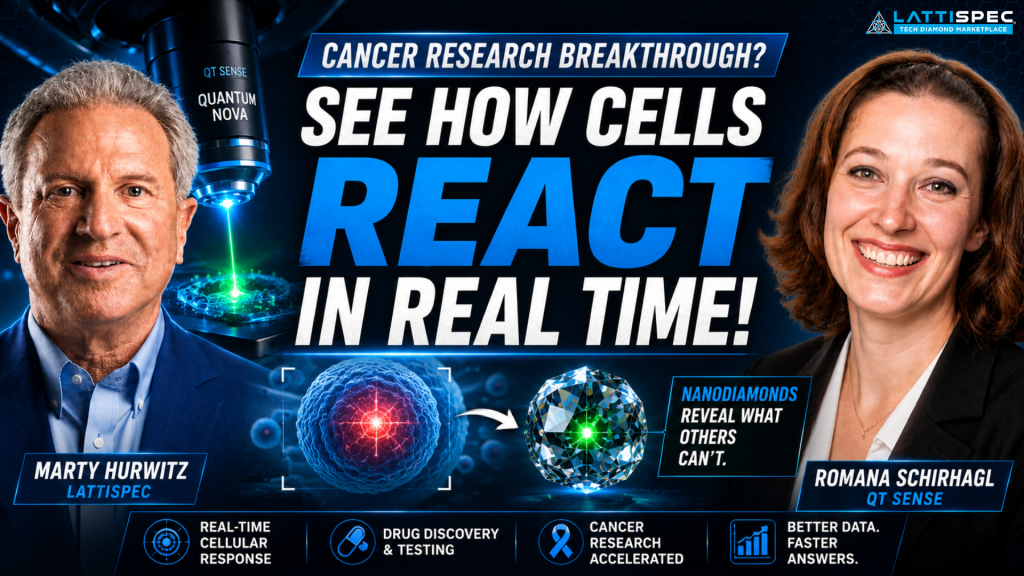
Dr. Romana Schirhagl: I mean, QT Sense is a, a baby company, so we were founded in 2024, so it’s, uh, all very new. I mean, the most exciting is that we are on the market, so we are selling the Quantum Nova. It’s a microscope that allows you to measure stress responses in cells. So we use nanodiamonds that we bring in cells, and then we measure stress responses there.
Now, even though we are a very young company, we are already selling in different countries and, and it’s really exciting to bring the product out there and to, yeah, to see how, how other people are using it and, and yeah, that’s very exciting.
Marty Hurwitz: The, the nanodiamonds part of this, I gather, were a critical component in the development of Quantum Nova. Why are nanodiamonds so important to this, uh, work?
Dr. Romana Schirhagl: Well, I mean, they are what has the quantum sensor, so you cannot do quantum sensing without the quantum sensor. So everything we do, we manipulate defects in diamond, so if you don’t have diamonds, then yeah, you, you cannot do quantum sensing or diamond-based quantum sensing. So it’s, it’s key.
Marty Hurwitz: Forgive this, uh, non-scientific question. You’re really changing the way cellular activity is monitored and measured in the human body. Before this, people were measuring things at a cellular level, but the cells were not living. Is that fair to say? You’re now monitoring cellular activity in real time.
Dr. Romana Schirhagl: Yeah, we are monitoring in real time. Mostly we don’t measure in the body, but we do a lot ex vivo, so that means, for example, when you take blood, then we do an analysis of that blood or surgical material. So, so for the clinical material that we use, we mostly get something that is removed from the body in, for example, if you have a cancer surgery, then the cancer is removed, and then we get that cancer, and then we can analyze it.
But we also do a lot with cell lines, um, to, to test certain mechanisms in biologies or how does something work in, in cells or also drug testing, how, how the– where and how does a drug work exactly? So this is also a type of questions that we look at.
Marty Hurwitz: Right. So yeah, drug delivery and drug discovery, I gather, are, are two key benefits as well. Is that fair to say?
Dr. Romana Schirhagl: Yes. I mean, we, we don’t do drug delivery ourselves, but we have a tool to, yeah, to measure what the effect of the drug is. So we can, for example, pinpoint, uh, if you add a drug, this part of the cell responds in this way. So, so this is basically what we do. And another thing that is very powerful that we can do is that we can do a measurement, then we make an intervention, so for example, we add a drug, and then we measure in the same cell, same particle, same everything again.
And this is very nice, uh, for biological point of view because normally you, you have to do that in different cells. So if I do this in different cells, if I make the drug group and the non-drug group in a different cell, then I don’t know if it’s different because the cells were different, or they were doing something different, or God knows what, or what is really my intervention.
And, and if you do it this way, you can really make everything its own control. So you can do everything is the same before and after, and, um, yeah, this way you can disentangle these differences. So what is really done by the drug and what is just different because it’s a different cell or different patient if you want.
Marty Hurwitz: So that’s pretty amazing. I mean, you’re– that shortens the testing and the research side of it, doesn’t it?
Dr. Romana Schirhagl: Yeah, it does. Yeah. Thank you. Yeah. So, so we– I mean, we have some experiments where we cannot do this before and after, and then indeed you need much more experiments because the, the differences are then much more difficult to, to observe.
LattiSpec Ad Read: LGDinTECH is now LattiSpec, a global tech diamond marketplace for buyers and sellers. From diamond material to sub-components to equipment, post growth treatment and services, LattiSpec helps bring more transparency and speed to the technology-grade grown diamond supply chain. Built for aerospace, defense, semiconductors, quantum, photonics, optics and more, LattiSpec connects you with verified global suppliers across ten verticals. LattiSpec is where the tech diamond market connects.
Marty Hurwitz: Now your, your company is progressing. Uh, even though you’re young, you’re moving pretty quickly. It sounds like there’s a lot of excitement about the Quantum Nova, uh, equipment in the marketplace. You’re, you’re already placing equipment in real use cases. Is that, is that true?
Dr. Romana Schirhagl: Yep. Yep, that’s true.
Marty Hurwitz: And what sort of, um, customers are using them now?
Dr. Romana Schirhagl: Yeah, all kind of different people. I mean, for now, uh, we don’t have a medical device certificate, so for now it’s all research use. And then, yeah, people that are doing medical research, so, so they aim to use the device at some point in diagnostics, but also researchers, people that just want to understand biology better, researchers in hospitals, companies that want to work with quantum sensing in some way.
So it’s, uh, different, all kind of different people. So i- in principle, it’s a microscope, and you can– The application is whatever you put under the microscope, right? So in that sense, it’s very versatile.
Marty Hurwitz: What has been their feedback so far, these early users? Uh, what type of feedback are you getting from them?
Dr. Romana Schirhagl: We don’t have an, an awful lot of feedback yet because we are not so long on the market. But, um, yeah, it basically works. That’s that’s the good part. I mean, we are, of course, not entirely there yet. There’s some things, like, where we could be even more user-friendly or things like that, so we are learning a lot as we deliver to customers.
But, um, yeah, mostly it seems to be quite positively received. It’s just something they– that’s completely new, they have no experience with. So yeah, it’s, uh, that’s really… I mean, most people have for the first time seen quantum sensing equipment. On the other hand, we also have some customers that are really experts in the field.
And then, I mean, these people also appreciate that they are used to home-built systems and something they, they put together themselves. And then they appreciate, first of all, that it’s quick. You, you just buy it, and then you have it. It’s different to have a commercial system that is much more user-friendly.
So, um, when, when you have your own home-built systems, all the decisions, everything that you have to make, it’s all, all you by hand. And, um, yeah, with the, with the commercial system, this is much more ironed out. Uh, yeah. It’s, it’s made for commercial use, right? So, uh, normally, the, the home-built systems, this is like my PhD students in my research group, for example.
I mean, they do a, a PhD in quantum science. But then, uh, this is not like if you have biologists or some pharma company or something, this is not the same type of users. So they, they don’t want to necessarily play with the equipment. They just want to answer their questions. And, and, uh, yeah, the, the equipment that we have, uh, in QT Sense is really, yeah, made for that, so that people can really answer their questions and don’t bother too much with playing with the microscope.
Marty Hurwitz: Right. I, I– And I imagine the users now that are putting the systems in their labs, uh, benefit from the technical experience and support that you offer them as opposed to them building the equipment themselves?
Dr. Romana Schirhagl: Yeah. Yeah. And, and I mean, we also have in my lab home-built equipment. And then for example, if you look at the software in, in the home-built equipment, it’s four different programs.
Uh, you have to know what you’re doing, everything. For example, which particles you measure, how does a good measurement look like? Um, uh, when do I know my experiment failed? All these, all these kind of things. I- in a home-built system, you really have to have all this knowledge, and in a commercial system, a lot of these things are done for you.


 LattiSpec Curator
Live
LattiSpec Curator
Live