Marty Hurwitz: So on magnetometry in general, particularly quantum diamond magnetometry, besides what you’re doing now, what other applications do you see being commercially viable in the near future or midterm future?
David Roy-Guay: Yeah, of course, magnetometers have been around for quite a while, and it’s really a technological platform.
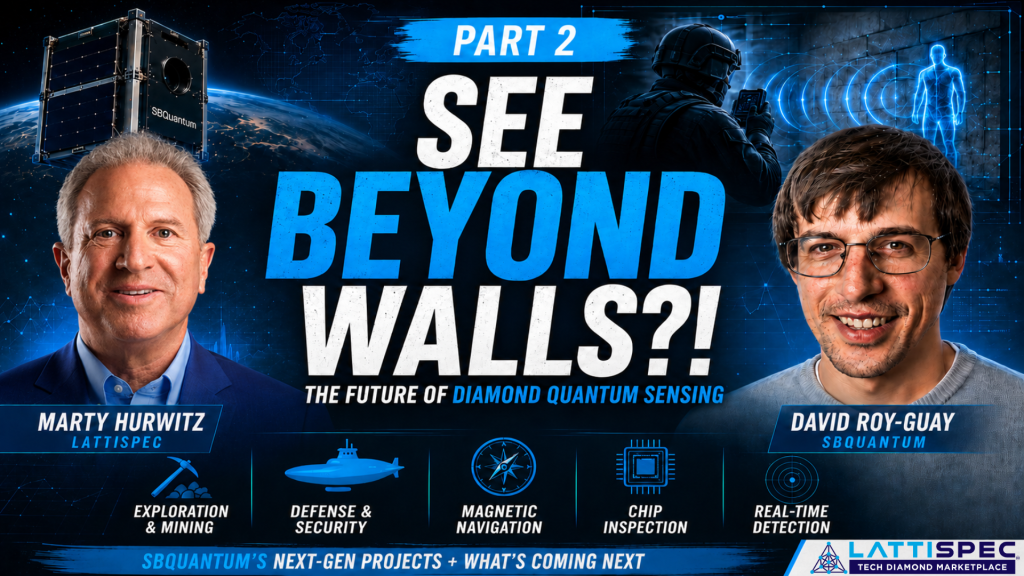
We’ve looked at 25-plus verticals of application, and over the years, we’ve looked mainly into four different verticals. One of them is exploration and mining. So magnetometers can be used to infer the geology of the ground and really enhance the targeting and drilling process when setting up new mines and expanding mines as well.
So that’s one application space. Another application space is defense and security. So one of the first uses of quantum magnetometers was in submarine hunting. Of course, a submarine, being a big metallic mass, will alter Earth’s magnetic field and create a local anomaly, which you can pick up with sensitive enough magnetometers.
And lastly, another application is magnetic navigation. An example is this mission that we sent to build a world magnetic map for the World Magnetic Model, which feeds into any electronic compass. There are also some people looking at other schemes to perform magnetic navigation using very detailed magnetic field maps that might be taken from space, airborne, or even on the ground.
So yeah, these are the main applications we’ve looked at. Of course, there are other applications in bio and health, like detecting contrast agents that might be magnetically functionalized, or inspecting chips to check if there have been alterations by adversaries in order to spy on you.
So there’s a wide variety of applications that can be thought of.
LattiSpec Ad Read: LGDinTECH is now LattiSpec, a global tech diamond marketplace for buyers and sellers. From diamond material to subcomponents, equipment, post-growth treatments, and services, LattiSpec helps bring more transparency and speed to the technology-grade grown diamond supply chain.
Built for aerospace, defense, semiconductors, quantum, photonics, optics, and more, LattiSpec connects you with verified global suppliers across 10 verticals. LattiSpec is where the tech diamond market connects.
Marty Hurwitz: What exciting things are you working on at SBQuantum? Any other projects that you can share with us?
David Roy-Guay: Yeah. So lots of exciting things are happening. The tech is in space, and we’re also looking at future missions. We’re working with the European Space Agency in developing the next version of our magnetometer, which will be 10 times more sensitive, 10 times more accurate – kind of a faster, better, stronger type of sensor.
We’ll be looking into more scientific applications like Earth observation and monitoring the Gulf Stream currents, which can create a magnetic field signal. That’s one part. We’re very excited because, for us, it’s a big improvement that’s going to come along in this new sensor. Another project that we’re very proud of is that we’ve taken the technology across the stack, meaning that we build the hardware and we build arrays of these sensors that we put together and add an extra layer of interpretation algorithms that takes all the inputs from the sensors and allows us, in real time, to infer where a magnetic object might be, what speed it’s moving, and possibly classify the object.
So we’ve been working with the Canadian Special Forces here in Canada to see beyond walls – to see metallic objects that might move in real time and begin providing warnings to the end users in a very simple way. This is great because usually the data that comes off from a magnetometer is like wiggly lines.
It’s very complicated data to interpret, and most of the time it’s done in post-processing. But by tailoring the directionality, the vector readings from the sensors, and combining that with interpretation algorithms, we can infer in real time for the end user what’s going on. So we’re very proud of this. We’ll be deploying the technology in the field with the end users in the next few months.
Marty Hurwitz: Outstanding.
David Roy-Guay: You’re specialized in diamond, right?
Marty Hurwitz: We’re just trying to ease the use of the material in as many different technical applications as possible. So there are about 100 diamond growers in the world, of which maybe 10% are even capable of growing for technological applications.
Most of them don’t have the PhD-level scientists on staff to work in an embedded way with product developers because, as you’ve probably learned, developing the diamond material to your specifications is complicated and takes a lot of trial and error. So we’re trying to help bring those diamond growers up to speed and introduce them to appropriate users of their material.
You mentioned developing the full stack. Actually, most of these diamond growers are not going to survive just supplying diamond material. It’s going to be commoditized too quickly. So they also have to shrink the supply chain to get closer to the product developers and, in fact, joint venture with them to develop new product applications that use their material, rather than just selling their material by itself.
David Roy-Guay: Yeah, that’s a very important point for us. You mentioned the supply chain issues, because when we’re looking at such specialized materials, these are very uniquely made in terms of quantum defect density. All the recipes to create these have decades of experience behind them.
And now we need to take this and turn it into a product, fit it in the magnetometer, and then all the dicing, the polishing, and preparing the samples to be put into the other subsystems is quite something else. That is not very conventional if we compare it to the jewelry industry, power electronics, and all that jazz.
Marty Hurwitz: Right. And if you have to start to scale it to any kind of quantity, not only are you going to have to do all of that technical work, but you’re going to have to figure out a price that makes it viable. And so where the product is grown and who is growing it becomes a critical piece because not only do they have to have the scientists on staff, but they also have to figure out how to produce it economically.
David Roy-Guay: Absolutely. And if we come back to your point about the diamond being commoditized, the magnetometers themselves are commoditized. Everybody has one in their cell phones. Even the most advanced magnetometers sell for a maximum of $10,000 USD. So it’s fairly commoditized. At SBQuantum, we’ve been very passionate about building these extra bricks that unlock additional value for the end users, and we think that’s the way to go.
Marty Hurwitz: Yeah, that’s definitely the way to go, and that’s where the margin is because the smaller your involvement, the lower the margin. The more you control the whole end product, the higher the margin.


 LattiSpec Curator
Live
LattiSpec Curator
Live