Marty Hurwitz: A Diamond Sensor Launched on SpaceX… To Reinvent Navigation.
David Roy-Guay: SBQuantum is a startup, a spinoff based out of the Institut quantique in Sherbrooke, Quebec, in the eastern part of Canada.
Really, our vision is to reap the full potential of magnetic sensing, and we’re doing that using quantum technology. We’re a 20-person business based mostly in Sherbrooke.
We have a few people in Montreal and one person in Boston. We’re building the full stack of magnetic sensing, which is not only limited to the hardware, but also includes the interpretation algorithms, so that we can interpret magnetic field signals in a way that has not been done before.
Marty Hurwitz: I read the news release about the launch of your quantum diamond magnetometer. Was that with SpaceX in March?
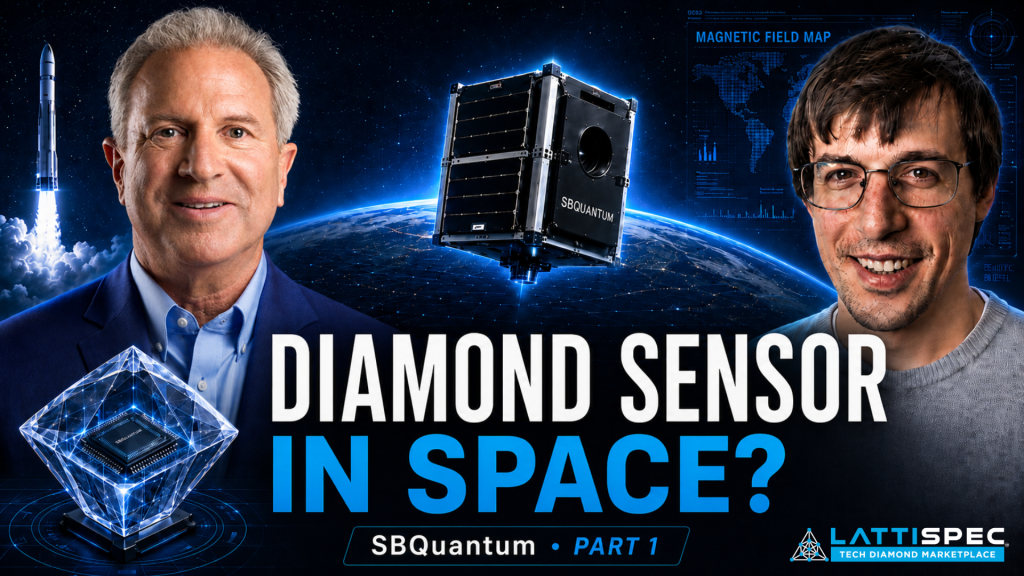
David Roy-Guay: Yeah. We launched just last Monday on a SpaceX rocket along with about 110 satellites.
We’ve been working for the last few years with Spire Global, and they actually launched nine satellites on the same day. We’re one of the missions.
Yes, we’re at the last phase of this MagQuest program to build and maintain the World Magnetic Model. We also launched alongside Iota Technology and the University of Colorado Boulder’s Compact Spaceborne Magnetic Observatory, known as COSMO CubeSat.
Really, the concept of the mission is taking our diamond-based magnetometer technology and using the high fidelity and high precision of diamond vectorial readings to build this essential asset, the World Magnetic Model.
Marty Hurwitz: Are you getting any feedback from that launch yet? Are you able to get results so far?
David Roy-Guay: Yeah. We got the initial ping back from the satellite, so we’re very happy that the launch was successful and that we can communicate with it.
Now Spire is the one doing the commissioning, and they’re going through a list of about 30 different steps, like booting the GPS systems and deploying the solar panels. We’re at the bottom of the list, interestingly.
So we’re still waiting eagerly to see the magnetic field data being output by our technology, because this is the first time that diamond technology, diamond magnetometer technology, is going into outer space. We’re very excited about that.
Marty Hurwitz: Oh, that’s really cool. It would be great to hear when you start getting tangible results back.
David Roy-Guay: Absolutely.
We’ll keep everyone posted on social channels, that’s for sure, and eventually release some kind of white paper with the feedback we’ll have from NGA and NOAA, so we can benchmark our data against previous missions.
Hopefully, this is only the beginning. We’ll send additional satellites in the future to produce even more accurate magnetic field maps.
Marty Hurwitz: Tell us why diamond, particularly technology-grade grown diamond, is so important to this work.
David Roy-Guay: One of the challenges for the MagQuest program was measuring the magnetic field vector, meaning the way Earth’s magnetic field is pointing, with a high level of accuracy.
Currently, there are classical technologies like fluxgate magnetometers, but these tend to drift with temperature. That is an issue if you’re thinking about building this global model.
Another way to do it is to use quantum-based magnetometers, such as atomic vapor magnetometers. However, these typically only measure the amplitude of Earth’s magnetic field, so you have to apply some scheme with coils to vectorize, or get the orientation of the magnetic field back.
That adds potential issues with refresh rates and the fidelity of the measurements.
What is really wonderful about diamond magnetometer technology is that within a small slab of diamond, a kind of purple chunk of synthetically grown diamond, there are four different sensing axes at the atomic level.
With the NV centers we’re using, the nitrogen-vacancy defect can sit on four different lattice sites. In effect, it creates a four-sensing-axis magnetometer.
We can combine that to infer, in real time, the temperature of the diamond and the vector magnetic field in a very small volume. That’s one important factor.
And since everything is solid state, it’s very rugged. All the ancillary systems to control and read out the system are optics-based and rely on non-resonant excitation and the collection of light re-emitted by these defects.
All of that together allows for very accurate vector magnetic field readings because everything is based fundamentally on the laws of quantum physics.
So we can always recalibrate and come back to the intrinsic calibration of the system. The fact that it is vectorial and rugged was key in allowing us to progress into the MagQuest program.
Marty Hurwitz: What are the key performance indicators from this space mission that you are hoping to achieve? And if you achieve them, where does that take you next?
David Roy-Guay: It’s a great question.
Actually, setting the right metrics for the MagQuest program has been very helpful for SBQuantum. Coming from a scientific background, from a physics background, the typical way to develop technologies is to chase perfection, to chase the ultimate boundaries of what the technology can offer.
However, for the MagQuest challenge, they were very pragmatic.
The objective was to measure Earth’s magnetic field with a precision of one nanotesla over 50,000 nanotesla, which is the typical value for Earth’s magnetic field. That’s roughly 20 ppm precision, so it’s a good degree of precision over an extended mission lifetime.
The second metric was sensitivity, meaning the smallest magnetic field changes we could measure. There, the metric is one nanotesla per square root hertz. That means if you average the signal for a second, you measure with a sensitivity of one nanotesla.
These are not very stringent requirements.
Some of the best magnetometers, in very specific environments, can perform to femtotesla sensitivity, which is orders of magnitude better. However, to build a worldwide magnetic map, the requirement is just one nanotesla. That was very realistic, but at the same time ambitious for diamond technology.
So it really allowed us to focus our efforts on maturing the technology and not chasing perfection. It helped speed up the development so that it’s in a portable format.
It has gone on drones, weather balloons, and airplanes, so it’s very rugged and ready for field deployment.
In terms of the second part of your question, what’s next for us, especially for the space program, is that this is a pilot mission.
We just launched in space. We’re going to check the quality of the data produced by the CubeSat.
If we get approval from NGA, we’ll proceed with a 20-year procurement program and send a new satellite every two to three years, integrating our magnetometer technology and all the processing involved in producing the World Magnetic Model.
Marty Hurwitz: So you mentioned pre-testing it in somewhat harsh environments, but now it’s in probably the harshest environment possible. I’m wondering, what is the life expectancy of it in space?
David Roy-Guay: We’re very hopeful that the limiting factor will not be the diamond technology itself, but actually the lifespan of the CubeSat, because it’s placed in low Earth orbit at about 600 kilometers altitude.
There will be some atmospheric drag. Depending on solar events, it might last two to three years in orbit.
That’s the timescale we’re looking at. Probably before it starts decaying too much, we’ll send a new satellite as a replacement.


 LattiSpec Curator
Live
LattiSpec Curator
Live